
TAX

Tax Relief Package for Businesses to Reduce Operating Costs at Thailand’s Latest.

January 26, 2021, Thailand’s government issued its latest tax relief package for businesses, as it continues to offer initiatives to alleviate the economic impact caused by the pandemic.

This latest package provides a reduction in the land and building tax, property transaction fees, in addition to an extension in the tax filing deadline for personal income tax (PIT), value-added tax (VAT), and withholding tax (WHT).

Thailand has issued an array of incentives throughout 2020 to assist businesses, households, workers, and the financial services sector. In April last year, the government provided its largest stimulus package valued at US$58 billion, equivalent to 10 percent of GDP.

Named Phase 3, the package saw US$15 billion provided to commercial banks to lend to SMEs in the form of soft loans. A further US$30 billion was allocated as financial aid for farmers and US$18 billion to temporary workers, contract workers, and self-employed persons. This includes providing 5,000 baht (US$154) in monthly handouts for six months.

Furthermore, the Board of Investment (BOI) — the main agency responsible for promoting foreign investments in Thailand — has also been active in trying to encourage more foreign investment through tax cuts and holidays for selected BOI projects.

In late 2020, the BOI provided corporate income tax (CIT) deductions for large-scale projects and for businesses seeking to adopt digital technologies in their operations.

The reduction of land and building tax

The government will provide a 90 percent reduction of the land building tax for 2021, which covers the following categories of land:

  • Agricultural;
  • Residential;
  • Commercial; and
  • Vacant land.

The tax payments are due in April of every year with the following applicable rates:
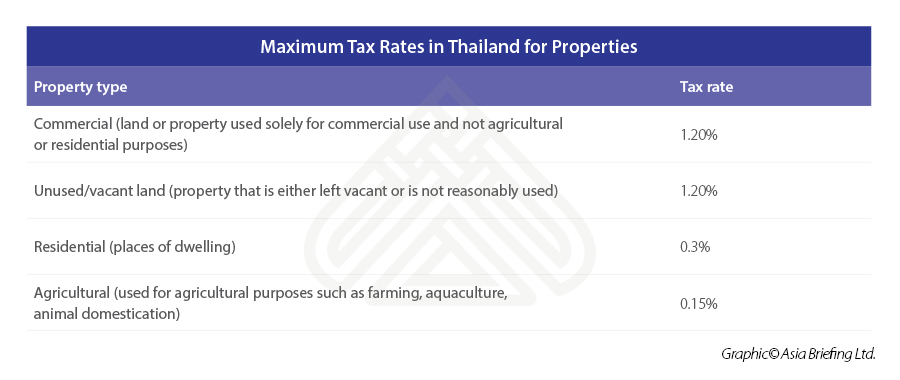
Maximum-tax-rates-properties-Thailand

If a property remains vacant for more than three consecutive years, the rate will be increased by 0.3 percent every three years until it reaches a cap of three percent.

Thailand’s new Land and Building Act was issued in 2019 and came into effect in January 2020. Prior to this act, tax rates on land and properties were assesses on an income-based method to an assessment based on the property’s value.

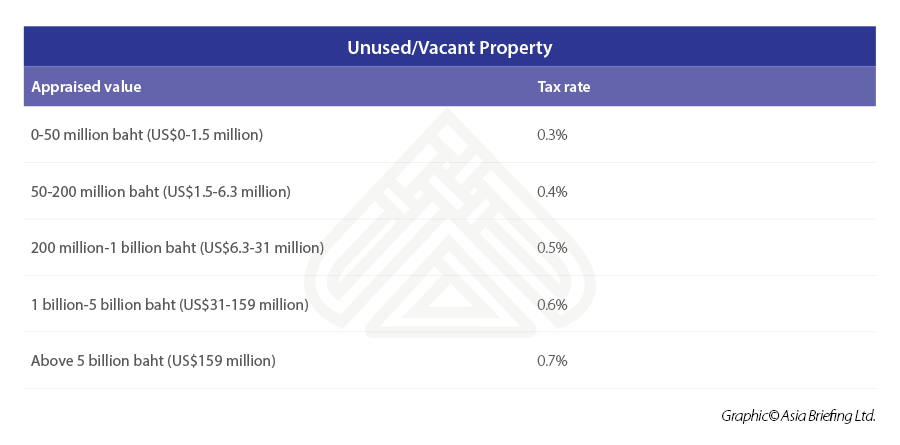
The Act does provide a two-year transition period starting January 1, 2020, to help property owners adjust to the new law. During this transition period, the tax rate has been further reduced which can be seen from the following tables.
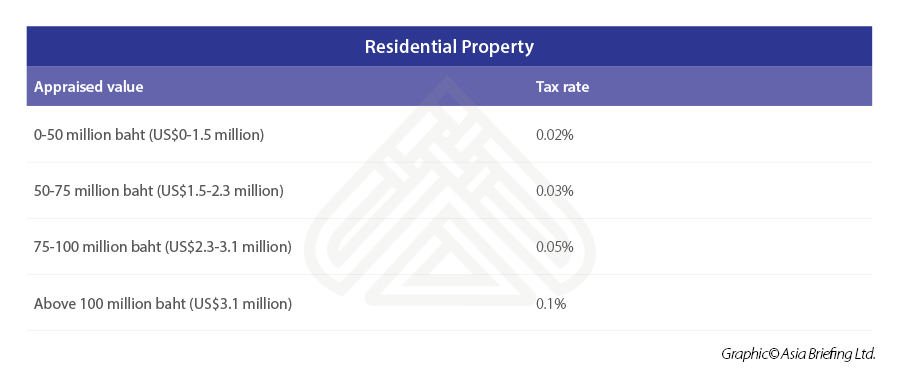
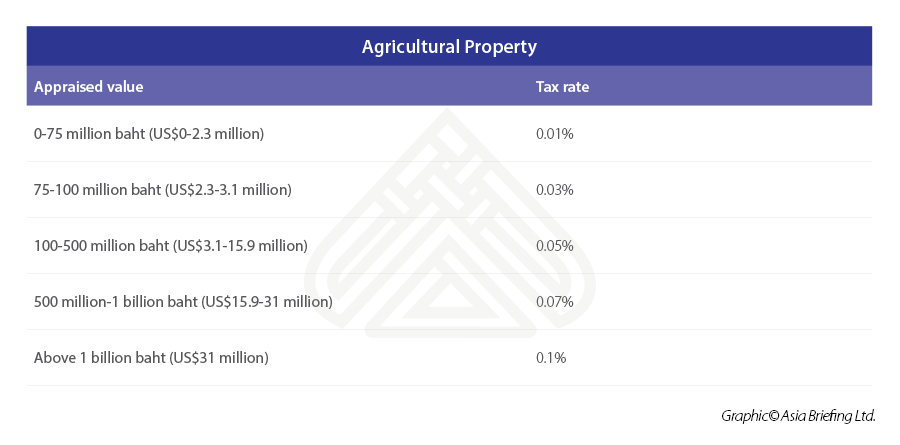
Residential-property-thailand-tax

Agricultural-Property

Unused-property-tax-Thailand

Thus, for 2021, if a residential property was appraised at five million baht (US$166,610), then the tax would be calculated as follows for those eligible:

5 million baht (US$166,610) x 0.02 percent tax rate = 1,000 baht (US$33.32).

1,000 baht x 90 percent tax reduction = 900 baht (US$29.98).

The final tax is 100 baht (US$3.33).

     The reduction of property transaction fees

To assist the sale of real estate in the country, the government has reduced the registration fees for real estate transfers from two percent to 0.01 percent, and mortgage registration fees from one percent to 0.01 percent.

This tax reduction applies to the following property categories:

  • Condominium registered below 3 million baht (US$100,014); and
  • Land with buildings, twin houses, detached houses, or commercial buildings being sold by an authorized land developer.

This incentive will be effective from January 12 to December 31, 2021.

     Extension of e-tax filing

The government has extended the deadline for PIT returns from March 31 to June 30, 2021. In addition, the deadline for WHT and VAT payments have been extended to the last day of each month from February to June 2021.

Thank You for News credit  :  https://www.aseanbriefing.com/
Facebook
Twitter
Pinterest

ความรู้/ข่าวสารที่คุณอาจสนใจ

Financial Annual Report 2025

Key Deadlines for Submitting Financial Statements (Fiscal Year 2025)

        As we enter 2026, many business owners are now receiving notifications from their accounting firms to prepare their “year-end closing documents” for the 2025 fiscal year.But did you know that the financial statement submission deadlines and forms differ between the Department of Business Development (DBD) and the Revenue Department (RD)?        Even a one-day delay can result in fines ranging from THB 1,000 to 200,000.So today, Nong Muang from ACC Consulting will summarize everything in simple terms — what needs to be filed, when, and what documents you should prepare. 📅 Key Deadlines for Submitting Financial Statements (Fiscal Year 2025)        For companies with a fiscal year ending on December 31, 2025 (a common accounting year-end for Thai businesses), here are the important deadlines: Task Deadline Remarks Filing Corporate Income Tax Return (Form PND.50) Within 150 days after fiscal year-end → if year-end is Dec 31, 2025 → file by end of May 2026 Example: Companies closing books on Dec 31, 2025 must hold the shareholder meeting by April 30, 2026, and

อ่านต่อ »
phuket-tax-accounting-risks

5 Accounting & Tax Risks Every Phuket Business Owner Should Know (And How to Avoid Them)

Title: 5 Accounting & Tax Risks Every Phuket Business Owner Should Be Aware Of (And How to Mitigate Them) In the realm of business ownership in Phuket, it is imperative for entrepreneurs to be well-versed in the potential accounting and tax risks they might encounter. Being proactive and informed about these challenges is key to avoiding detrimental financial consequences. By understanding and addressing these risks head-on, Phuket business owners can safeguard their financial integrity and ensure compliance with relevant laws and regulations. 📍 Operating a business in Phuket?           Whether you’re running a café in Old Town, managing a resort near Patong, or launching a new real estate venture—staying compliant with Thai tax and accounting laws is crucial.           Here are 5 common accounting and tax risks we’ve seen in Phuket-based businesses, and how you can protect your company from unnecessary penalties or investigations. 🔻 1. Mixing Personal and Business Finances Risk: Failing to separate business and personal expenses can lead to inaccurate books and potential tax issues.Solution: Open a dedicated business

อ่านต่อ »

Accounting, Tax, and Audit Services for Businesses in Phuket

📍 Supporting Businesses in Phuket with Professional Financial Services           Phuket is one of Thailand’s most dynamic business destinations, especially in hospitality, real estate, F&B, and tourism. At ACC CONSULTING CO., LTD, we understand the specific challenges and compliance needs of businesses operating in Phuket. Our expert team of CPAs, accountants, and tax advisors is ready to support your operations with reliable and secure online services—no matter where you are in the province. 💼 Our Key Services ✅ Company Registration & Business Structuring Incorporation of Limited Companies / Partnerships / Sole Proprietors VAT registration, social security setup, DBD documentation Shareholder agreements and legal consulting ✅ Monthly & Annual Accounting Services Thai GAAP-compliant bookkeeping (TFRS for NPAEs) Monthly PND/VAT submissions (PND.1, 3, 53, 50, 51, PP.30) Digital reports and e-document submission ✅ Professional Tax Planning Strategic structuring to minimize tax liability Income tax optimization, expense classification Advisory for property/investment transactions ✅ Certified Audit by Thai CPAs Annual audit reports for DBD & Revenue Department Financial statements with explanatory notes Audit-ready for companies exceeding threshold 🏨 Industry Focus

อ่านต่อ »

By clicking “Accept”, you agree to the storing of cookies on your device to enhance site navigation, analyze site usage, and assist in our marketing efforts. Privacy Policy

Privacy Preferences

คุณสามารถเลือกการตั้งค่าคุกกี้โดยเปิด/ปิด คุกกี้ในแต่ละประเภทได้ตามความต้องการ ยกเว้น คุกกี้ที่จำเป็น

Allow All
Manage Consent Preferences
  • Always Active

Save